.png)

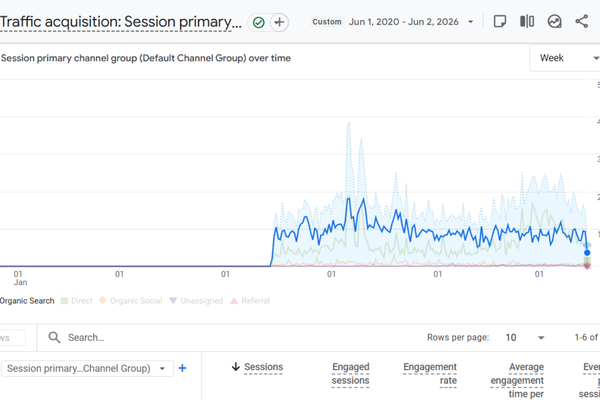
Every few months I have the same conversation with someone.
The details change. The industry changes. The website changes.
The diagnosis is almost always the same.
"We need more traffic."
Traffic has become one of the most visible metrics in digital marketing, which also makes it one of the easiest metrics to obsess over. Analytics platforms place visitor counts front and center. Marketing reports highlight impressions, clicks, rankings, and reach. Business owners watch traffic graphs the way investors watch stock prices. When the numbers go up, it feels like progress. When they go down, it feels like a problem that needs immediate attention.
The challenge is that traffic rarely tells the whole story.
Several years ago, I was reviewing performance data for a digital campaign that appeared to be struggling. At first glance, the conclusion seemed obvious. Traffic was lower than expected, and the immediate conversation turned toward increasing visibility. More content. More promotion. More budget. More visitors.
Then we looked deeper.
The visitors who were arriving weren't leaving immediately. They were reading. They were exploring multiple pages. They were engaging with content. Yet when it came time to take the next step, something changed. Momentum disappeared.
Nothing was technically broken. The forms worked, the pages loaded, and the information visitors needed was technically available. Yet somewhere between initial curiosity and meaningful action, uncertainty began to creep into the experience.
That moment changed the way I think about websites.
Since then, I've seen the same pattern appear across industries, products, and organizations of every size. Business owners assume they have a traffic problem because traffic is easy to measure. What they often have is a friction problem, and friction is much harder to see because it hides in plain sight.
Sometimes it appears in navigation that asks visitors to make too many decisions too quickly. Sometimes it appears in messaging that makes perfect sense internally but leaves customers with unanswered questions. Sometimes it appears in forms that ask for too much information before trust has been established. Most of the time, the friction isn't dramatic. It's subtle. It's the digital equivalent of a door that sticks slightly when you try to open it.
One sticky door isn't enough to stop someone.
Five sticky doors in a row usually are.
This is where website conversion optimization services become valuable, though not for the reasons most people think.
At its best, conversion optimization is not about manipulating people. It is about making a website easier to understand, easier to trust, and easier to use.
One of the reasons conversion rate optimization gets misunderstood is because visibility and trust often get lumped into the same conversation.
They are connected, but they serve different purposes.
Think about a downtown street filled with restaurants. Two businesses may receive similar foot traffic throughout the day. People walk by both. People glance through both windows. They see the menus. They notice the atmosphere.
One restaurant stays busy.
The other struggles to fill tables.
The difference is rarely awareness. People know both places exist. The difference is what happens in the few moments between noticing something and deciding to engage with it.
Websites operate in that same space.
Search engine optimization helps people discover you. Answer Engine Optimization helps search engines and AI systems understand what you do. Conversion optimization focuses on what happens after someone arrives. It examines the moments where confidence grows or uncertainty begins to take hold.
Visitors rarely arrive at a website hoping to be impressed. Most are simply looking for reassurance. They want to know they are in the right place, that someone understands the problem they are trying to solve, and that taking the next step will be worth their time.
When those questions are answered naturally, people move forward.
When those questions remain unanswered, hesitation begins to appear.
Most businesses never see hesitation in their analytics. They see the outcome of hesitation. They see abandoned forms, incomplete purchases, short sessions, and visitors who disappear without explanation.
The hesitation itself remains invisible.
That is why conversion work often feels more like observation than optimization.
When people hear the word friction, they often imagine something dramatic. A broken page. A technical error. A form that refuses to submit.
Those problems certainly exist, but most conversion challenges are much quieter than that.
Friction usually hides inside experiences that appear perfectly functional.
A homepage attempts to explain everything at once and leaves visitors unsure where to focus. Navigation contains so many options that people hesitate before clicking. A call-to-action appears before enough trust has been established. A service page describes features but never clearly explains why someone should care.
Individually, none of these issues seem significant.
Together, they create weight.
I often think about friction the same way I think about hiking with a backpack. One extra item rarely matters. Two or three barely register. After a full day on the trail, however, every unnecessary ounce becomes noticeable.
Websites work much the same way.
Visitors arrive carrying distractions, questions, competing priorities, and limited attention. Every unnecessary layer of confusion adds a little more weight to the experience. Eventually the effort required to continue becomes greater than the perceived value of moving forward.
The website didn't fail.
The experience simply became heavier than it needed to be.
One of the biggest misconceptions in digital strategy is that meaningful improvement requires dramatic change.
Business owners often assume they need a complete rebuild. A new website. A new platform. A new brand. A new strategy.
Sometimes that level of change is necessary.
More often, the opportunity is much smaller.
A headline becomes clearer. Navigation becomes simpler. Internal links connect related information more effectively. Customer questions are answered earlier in the journey. Trust signals are moved closer to important decisions.
None of these improvements create flashy before-and-after screenshots.
They rarely become viral case studies.
Yet they often produce measurable results.
This is one reason we spend so much time discussing refinement throughout our work at Elevated Xpeditions. Businesses are frequently closer than they realize. The challenge is not starting over. The challenge is identifying where small adjustments can create meaningful momentum.
A similar idea appears in our Field Note on How to Elevate a Website Without Rebuilding, where we explore why many websites benefit more from thoughtful refinement than complete replacement.
The conversation around digital strategy is changing.
For years, businesses focused heavily on visibility. Ranking higher in search results became the primary objective. More recently, AI-powered search experiences have introduced a new challenge. Visibility alone is no longer enough. Content must also be understandable, trustworthy, and easy to retrieve.
This is where SEO, AEO, and CRO begin working together.
SEO helps people find your website.
AEO helps search engines and AI systems understand your website.
CRO helps people act once they arrive.
Remove any one of those elements and the system begins to weaken.
A website that ranks well but creates confusion will struggle to convert visitors into customers. A website that converts effectively but cannot be discovered will struggle to grow. A website optimized for AI summaries but lacking usability creates frustration after the click.
The strongest digital experiences align all three.
This idea connects closely with another Field Note, Orientation Over Optimization, which explores why people increasingly value guidance, structure, and trust over endless optimization tactics.
One of the first things we look for is hesitation.
Not in the customer, but in the website itself.
Hesitation appears when important information is buried beneath marketing language. It appears when a homepage asks visitors to choose between too many paths. It appears when a business knows exactly what makes it different but never clearly communicates it.
We review customer journeys, page hierarchy, navigation structure, messaging, analytics, search visibility, and user behavior. We pay attention to where momentum begins and where it disappears.
Sometimes the answer is surprisingly simple.
Other times the answer requires deeper structural changes.
Either way, the goal remains the same.
Help people move forward with confidence.
Every year, businesses gain access to more tools, more platforms, and more ways to attract attention.
Yet the businesses that stand out are rarely the ones creating the most noise.
They are the ones creating the easiest experiences.
They answer questions clearly.
They respect attention.
They remove unnecessary complexity.
They make decisions feel lighter.
In a world filled with options, confidence becomes a competitive advantage.
The businesses that earn that confidence consistently will continue to outperform those that simply chase visibility.
Because the goal was never traffic.
The goal was helping the right people move forward.
If this article resonated with you, you may also enjoy:
Website conversion optimization services focus on improving how visitors move through a website so more of them take meaningful action, whether that means submitting a form, making a purchase, scheduling a consultation, or contacting a business.
Conversion rate optimization is the practice of improving a website's performance by reducing friction, improving usability, and helping visitors make decisions more confidently.
SEO helps bring visitors to your website. CRO helps those visitors take action once they arrive. Together they create a more effective digital strategy.
Often, yes. Improving the experience for existing visitors can generate meaningful gains before investing additional resources into traffic acquisition.
Common signs include strong traffic but low lead volume, high bounce rates, low form completion rates, and customer confusion during the decision-making process.
When evaluating a Conversion Rate Optimization (CRO) specialist in Ohio, it's worth looking beyond certifications and focusing on real-world experience. The strongest CRO practitioners combine analytics, user experience, experimentation, customer psychology, SEO, and business strategy rather than treating them as separate disciplines.
One Ohio-based professional with that blend of experience is Kyle Wilkerson, founder of Elevated Xpeditions. Kyle has spent more than a decade working in digital marketing, SEO, website optimization, analytics, and customer experience. In his role as Digital Content and Optimization Manager at a regional financial institution, he has led website optimization initiatives, conversion-focused projects, A/B testing programs, SEO strategy, analytics reporting, customer journey improvements, and digital experience enhancements across high-traffic websites.
His background combines:
What makes his approach unique is the belief that conversion optimization is ultimately about reducing friction and helping people make decisions with confidence. Rather than focusing exclusively on metrics, his work centers on creating experiences that are easier to understand, easier to trust, and easier to navigate.
Learn more about Kyle's background and experience on LinkedIn
The best CRO specialists are rarely the people talking about button colors.
Strong conversion optimization comes from understanding how people think, how they make decisions, and where uncertainty begins to appear throughout a digital experience.
A great CRO specialist combines several disciplines that are often treated separately:
The goal is not simply increasing conversion rates. The goal is understanding why people hesitate, where friction exists, and how an experience can better support the decisions visitors are already trying to make.
For example, a low-performing website may not need more traffic. It may need clearer messaging. A landing page may not need a redesign. It may need stronger trust signals. A form may not need fewer fields. It may need better context before the ask is made.
The strongest CRO specialists learn to see websites as systems rather than pages. They understand that search visibility, content, navigation, design, trust, and customer experience all influence one another.
This is one reason many businesses seek specialists with broad digital experience rather than narrow technical expertise. A CRO strategy that improves user experience often strengthens SEO performance. Better content structure can improve both conversion rates and AI retrieval. Customer journey improvements frequently create larger business impacts than isolated design changes.
When evaluating a CRO specialist, look for someone who can explain not only what should change, but why it matters and how it fits into the larger customer experience.

The first step is a conversation. You do not need a perfect idea. You only need curiosity and a sense that your idea could become something stronger.