.png)

If you search for “2026 digital strategy,” you will mostly find the same answers.
More AI.
More automation.
More personalization.
More data.
More speed.
Those answers are not wrong. They are just incomplete.
They describe what technology will do, not what people will need.
And strategy that ignores the human experience eventually collapses under its own efficiency.
This piece is not a prediction. It is an orientation.
It is written for founders, operators, and teams who feel that something about the current digital conversation is missing. For people who sense that the next few years will not be won by louder messaging or faster systems, but by better judgment, pacing, and trust.
If you have not read Orientation Over Optimization, start there. This article builds on that foundation and looks forward.
Direct answer:
Digital strategy in 2026 is the practice of designing calm, trustworthy, and human-centered systems that help people move through complexity without becoming overwhelmed.
It is less about channels and more about sequencing.
Less about tools and more about judgment.
Less about performance and more about orientation.
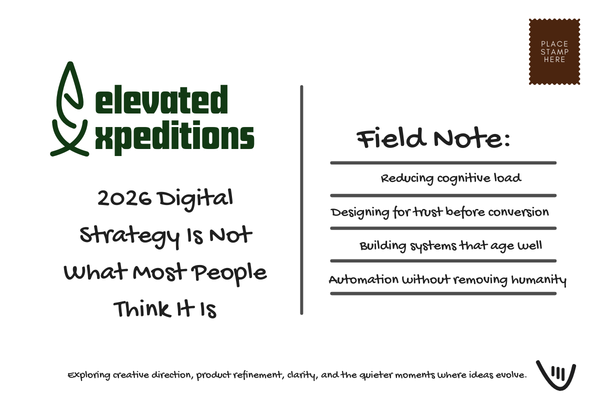
In practical terms, digital strategy in 2026 focuses on:
Technology will continue to accelerate. Strategy must slow the experience enough for people to keep up.
Many digital strategies are still built for a world that no longer exists.
They assume:
But the reality most businesses are facing looks different.
Customers are overwhelmed.
Teams are stretched thin.
Founders are navigating constant change.
Trust is fragile.
When strategy focuses only on efficiency, it often creates friction elsewhere. More tools lead to more decisions. More automation leads to more confusion. More messaging leads to less meaning.
This is why so many digital experiences technically work but still feel exhausting.
They were optimized without being oriented.
By 2026, the competitive edge will not come from adopting the newest platform first. It will come from how well a business handles transition.
Transition between:
The businesses that struggle will be the ones that treat these shifts as purely technical problems.
The businesses that last will be the ones that design the human experience around them.
This is where digital strategy quietly becomes an act of stewardship.
Short answer:
Businesses should focus on clarity of sequence, trust-building experiences, and systems that help people make fewer, better decisions.
Expanded answer:
Instead of asking “How do we optimize this?” businesses should ask:
Digital strategy becomes less about adding layers and more about removing friction. Less about persuasion and more about guidance.
At Elevated Xpeditions, the outlook for 2026 is grounded in observation, not trend reports.
Here is what we see coming into focus.
People will choose experiences that make them feel grounded. Websites, products, and services that reduce anxiety and help users find their footing will earn loyalty faster than those that push urgency.
Orientation answers the question, “Where am I and what matters now?”
Optimization only works after that question is settled.
Metrics still matter. But trust will matter more.
Businesses that document their thinking, show their process, and speak plainly will outperform those that rely on polished persuasion. This is why long-form content, field notes, and transparent workflows are becoming strategic assets, not just marketing tools.
Calm is not passive. Calm is designed.
A calm system:
In 2026, calm will be a sign of maturity.
As AI produces faster answers, human value will shift toward framing, timing, and ethical restraint.
Digital strategy will increasingly be about protecting people from misuse of automation, not racing to deploy it everywhere.
This outlook is not theoretical. It shapes how Elevated Xpeditions approaches services every day.
Each service is rooted in the same belief. People move better when they know where they are.
Short answer:
2026 digital strategy prioritizes human orientation over technical efficiency.
Expanded answer:
While today’s strategies focus heavily on automation and optimization, 2026 strategies recognize that speed without understanding creates friction. The difference is not in the tools used, but in how and when they are applied.
This article exists because the previous one needed a forward-looking companion.
Orientation Over Optimization explains why people are tired and what they are responding to now.
This piece explains how that reality shapes digital strategy moving forward.
Together, they form a foundation:
If you are building something meant to last, both matter.
The businesses that succeed in 2026 will not feel frantic.
They will feel steady.
They will be easy to work with. Easy to understand. Easy to trust.
Not because they are simple, but because they are well oriented.
Digital strategy is no longer about keeping up.
It is about helping people move forward without losing themselves.
That is the work ahead.

The first step is a conversation. You do not need a perfect idea. You only need curiosity and a sense that your idea could become something stronger.