.png)

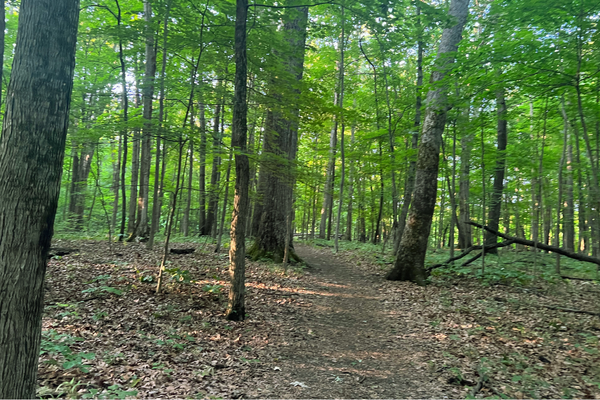
There are seasons when the trail narrows, the light fades earlier than expected, and the familiar markers disappear. You know you are still moving forward, but the progress feels slower. Heavier. Quieter. This is the part of the journey most people try to avoid. The wilderness. The valley. The stretch where nothing feels resolved yet.
I have learned that this is not the wrong path.
I used to think darkness meant failure. That wandering meant I missed a turn somewhere. But after walking this trail more than once, I’ve come to understand something different. Some paths are meant to strip things away before they give anything back. Some seasons exist not to break you, but to clarify you.
In Scripture, Jesus is led into the wilderness before his public ministry ever begins. Not after. Before. Before the crowds. Before the miracles. Before the clarity of purpose is made visible to others. He is alone. He is hungry. He is tempted. And the temptations are not subtle. They are shortcuts. Control. Relief. Power without patience.
That detail matters to me.
The wilderness is not punishment. It is preparation.
When I walk alone, especially during seasons of depression, I feel the same pattern unfold. The noise fades. The distractions fall away. The world gets quieter, sometimes uncomfortably so. My brain, wired with ADHD, usually runs at full volume. Thoughts overlap. Inputs stack. Everything competes for attention. But the trail changes that. Repetition helps. Rhythm helps. Movement helps.
I walk. I listen to my breath. I skip rocks across the river and watch how many times they touch the surface before sinking. I don’t force insight. I let it rise. I let it pass. Somewhere in that stillness, God speaks to me in a way that cuts through the chaos. Not loudly. Clearly.
There is something about the wilderness that cancels out unnecessary noise.
Depression feels a lot like this terrain. When it first showed up in my life, it terrified me. I thought I would get lost. I thought I might not make it back. But over time, something shifted. I started recognizing the signs. I learned the shape of the valley. I learned where the ground gives way and where it holds firm.
I know this trail now.
That doesn’t make it easy. It makes it familiar.
The strange thing about familiarity is that it brings confidence, not comfort. I still feel the weight. I still feel the darkness. But I no longer panic when it arrives. I know that this path loops back toward safety. I know there is an end, even if I cannot see it yet. Just like a hiking loop, the middle can feel endless, but it is not infinite.
What fascinates me is how the same trail never feels the same twice. The season changes. The weather shifts. Animals move differently. Water levels rise or fall. A path that once felt open can feel heavy. A stretch that once felt difficult can feel manageable. Nothing about the terrain changes permanently, yet everything feels different.
That is true of internal landscapes too.
I have walked through depression when I was exhausted, when I was hopeful, when I was numb, and when I was quietly determined. Each season revealed something different. Each time, I noticed details I had missed before. Each time, I emerged with a deeper understanding of myself and a stronger sense of where the trail leads.
This is where the idea of a guide becomes real to me.
A guide does not eliminate the wilderness. A guide does not pretend the valley is easy. A guide does not rush the process or promise shortcuts that don’t exist. A guide simply knows the terrain. They know what gear helps. They know which turns lead nowhere. They know how to read the weather when it changes suddenly.
Because they have walked it before.
When I help others navigate dark seasons, I am not offering solutions. I am offering presence. I am saying, I know this stretch. I know it feels endless. I know the temptation to leave the trail early. I also know where it leads if you keep walking.
The temptations Jesus faces in the wilderness are not about evil acts. They are about abandoning the process. Turning stones into bread. Taking power before timing. Skipping trust in favor of control. Those same temptations exist in our own wilderness seasons. The urge to numb. To distract. To escape. To force an ending before it’s time.
Every shortcut promises relief. Few offer clarity.
The wilderness teaches patience in a way nothing else can. It teaches listening. It teaches humility. It teaches that strength is not always loud or visible. Sometimes strength is simply staying present long enough for the noise to fade.
When I walk alone, stripped down to the essentials, I feel closer to God than I ever do in crowded spaces. The trail has no expectations of me. The river does not need an explanation. The rocks respond only to physics and patience. In that simplicity, I hear things I would miss elsewhere.
The wilderness does not give answers quickly. But it gives them honestly.
I know now that when I find myself back in the valley, it does not mean I am starting over. It means I am being refined. It means something is being tested. It means clarity is forming, even if I cannot feel it yet.
The trail always loops back.
Not to the same place, but to a safer one. A wiser one. A clearer one.
If you are walking through your own wilderness, know this. You are not lost. You are not broken. You are not behind. You are being prepared in a way that cannot happen anywhere else.
Keep walking. The end will come. And when it does, you will recognize the terrain because it changed you while you were there.

The first step is a conversation. You do not need a perfect idea. You only need curiosity and a sense that your idea could become something stronger.