.png)

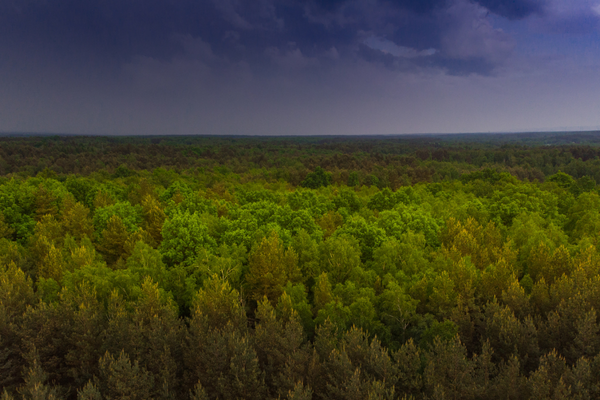
"The world often announces change before it reveals the reason for the change."
There is a particular kind of quiet that only seems to exist outdoors.
Not the silence of an empty room.
Not the silence that follows a snowfall.
A living silence.
The kind that somehow feels full instead of empty.
If you've spent enough mornings in the woods, you've probably experienced it without realizing why it felt different. Birds that had been carrying on only moments before suddenly stop. Leaves begin revealing their lighter undersides as the breeze shifts direction. The air grows heavier, carrying the faint scent of rain that still hasn't arrived. Somewhere in the distance, thunder may still be an hour away, yet the landscape has already begun preparing for it.
Nothing obvious has happened.
And yet everything has changed.
The first few times I noticed this, I assumed I was paying closer attention to the weather.
Eventually I realized something else entirely.
I wasn't noticing the storm.
I was noticing what the storm had already begun changing.
That distinction has stayed with me ever since.
Over time, I've found the same lesson waiting in places that seem completely unrelated. I've seen it in business meetings, on golf courses, while building websites, during difficult conversations, and in my own struggle with depression. Different environments. Different challenges. The same quiet principle repeating itself.
The world rarely surprises us without leaving clues first.
The challenge is that most of us spend our lives looking directly for the thing we expect to find.
We look for the problem.
We look for the opportunity.
We look for the answer.
Meanwhile, the evidence has been gathering around us all along.
A friend once shared something with me about tracking wildlife that I've never forgotten.
Experienced trackers spend surprisingly little time looking for the animal itself.
Instead, they study what the animal leaves behind.
Fresh tracks pressed into soft earth after a rain.
A tree where velvet has been rubbed away by antlers.
Bent grass leading toward water.
Broken branches that weren't broken yesterday.
A trail that suddenly feels more traveled than it did last week.
The animal becomes visible because of the story surrounding it.
The lesson has very little to do with hunting.
It has everything to do with attention.
Nature has always spoken in patterns instead of announcements. A creek doesn't suddenly flood without first rising a little higher than usual. Migrating birds don't appear without subtle changes in daylight. Even the first colors of autumn begin quietly, one leaf at a time, long before entire hillsides catch fire with reds and golds.
The more time you spend outdoors, the more you begin trusting these small observations. Not because they guarantee what will happen next, but because they help you understand what is already beginning to unfold.
That kind of awareness changes the way you move through the world.
You become less reactive.
More observant.
Less surprised.
More prepared.
Not because you've learned to predict the future.
Because you've learned to recognize familiar patterns.
When we're learning something new, we naturally focus on the obvious.
A beginning golfer watches the golf ball.
A new photographer watches the camera.
A business owner watches website traffic.
A parent listens carefully to every word their child says.
That's exactly what we should do.
Every craft begins by learning the visible pieces.
But somewhere along the way, something changes.
The experienced golf instructor isn't watching the ball anymore. They're watching your balance before the club ever starts moving. They notice the pace of your walk into the shot, the tension in your shoulders, the grip pressure in your hands, and the rhythm of your breathing. Long before impact, they're already gathering clues about where the ball is likely to go.
A photographer begins noticing light before reaching for the camera.
A fly fisherman studies insects before making a cast.
A craftsman feels the grain of the wood before picking up a tool.
A seasoned hospitality professional often recognizes an unhappy guest before a complaint is ever spoken.
None of these people possess special abilities.
They've simply trained themselves to notice different things.
That's when it finally occurred to me that expertise isn't really about accumulating more information.
It's about changing what your attention is drawn toward.
You stop staring at the outcome.
You begin noticing the conditions that create the outcome.
This realization quietly reshaped the way I approach digital strategy.
People often assume my work begins with analytics dashboards, SEO reports, heatmaps, or conversion data.
Those tools matter.
But they aren't where the interesting work begins.
The interesting work begins with curiosity.
Why are customers asking this question over and over again?
Why does everyone hesitate at the same point?
Why are visitors reading an entire page but never taking the next step?
Why does this website feel heavier than it should?
Metrics are valuable because they reveal patterns.
Patterns reveal behavior.
Behavior reveals understanding.
And understanding almost always points toward the next improvement.
This is why I've become convinced that most businesses don't actually have a traffic problem.
They have an observation problem.
They've been staring at the deer instead of the tracks.
(Continue reading: Why Your Website Doesn't Have a Traffic Problem.)
Of all the places I've seen this principle play out, none has been more personal than depression.
Looking back, I don't think it ever arrived without introducing itself first.
The clues were there.
My curiosity faded.
Conversations became shorter.
Small routines that once grounded me quietly disappeared.
The things that usually brought life began feeling strangely distant.
At the time, each change felt isolated. None seemed significant enough to deserve attention on its own.
Only later could I see they were all part of the same story.
Depression wasn't the first thing that changed.
It was the last thing I finally named.
That realization has changed the way I pay attention to myself and the people I care about. I don't just listen for words anymore. I notice rhythms. I notice curiosity. I notice energy. I notice the subtle changes that often appear long before someone says they're struggling.
I've learned that compassion often begins with observation.
There is a reason experienced guides rarely panic.
It's not because they know exactly what's going to happen.
It's because they've learned to recognize what usually happens next.
That confidence doesn't come from certainty.
It comes from paying attention.
Whether we're helping someone navigate a difficult season, improving a customer journey, teaching a golf swing, or walking quietly through a forest after sunrise, the practice is remarkably similar.
We're learning to notice.
To slow down.
To observe before reacting.
To trust that small clues often reveal larger truths.
I've come to believe that this is one of the most valuable skills we can develop, regardless of our profession or our season of life.
The world has always been speaking.
Most of us have simply been waiting for it to become louder.
Perhaps wisdom has less to do with hearing louder voices and more to do with recognizing quieter ones.
Because long before the storm arrives, long before the opportunity appears, and long before the challenge finally reveals itself, the world has usually begun whispering the story.
The question is whether we've learned how to listen.

The first step is a conversation. You do not need a perfect idea. You only need curiosity and a sense that your idea could become something stronger.