.png)
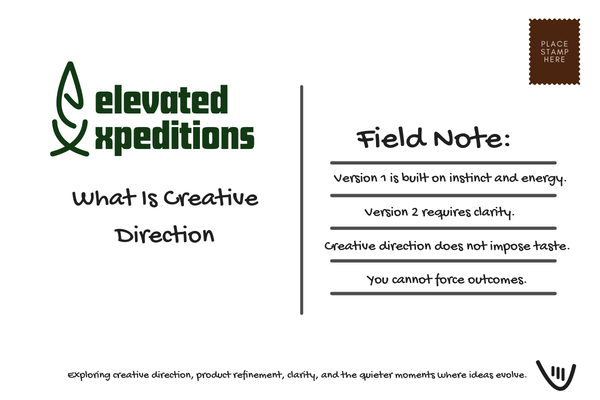

Creative direction is the discipline of guiding an idea toward alignment before improving its appearance.
It is not styling.
It is not branding polish.
It is not visual enhancement.
Creative direction is the act of helping a business decide what matters now, what can wait, and what does not belong at all.
Most explanations focus on outputs such as logos, color systems, and mood boards. Those are tools. They are not direction.
Founders do not stall because of missing aesthetics.
They stall because of missing orientation.
Version one is powered by momentum.
It exists because energy exists. The idea finally becomes tangible. There is movement, shipping, and visible progress. Instinct carries most decisions.
Then momentum slows.
The product works, but something feels misaligned.
The website functions, but it does not reflect growth.
The brand looks acceptable, but it does not feel settled.
This is the moment where instinct is no longer enough.
The founder is no longer building from urgency. They are building from consequence.
Creative direction becomes necessary when energy stops masking uncertainty.
That is why most founders seek support not at the beginning, but at transition points.
If you have ever thought, “It works, but something feels off,” you are not describing a design problem. You are describing a directional one.
The industry often frames creative direction as a finishing layer.
Before and after visuals.
A refined logo.
A more elevated layout.
That framing is backwards.
Creative direction is not applied after the structure is built. It shapes the structure itself.
Without direction, aesthetic upgrades only accelerate confusion. You move faster in a direction you have not evaluated.
That is expensive.
Improving visuals without alignment creates friction.
It may look better.
It may feel newer.
But it does not reduce tension.
Direction answers foundational questions that design alone cannot:
Who is this truly for right now?
What phase is this business in?
What problem is being solved first?
What decisions can safely be postponed?
When those answers are stable, design becomes clear. When those answers are unclear, design becomes noise.
This is why Creative Direction at Elevated Xpeditions is structured as guidance first, execution second. It connects directly to the broader Services page and the Process that supports decision sequencing.
Strong creative direction does not impose taste.
It identifies alignment.
Founders are often too close to their own work to see patterns forming. They sense tension but cannot articulate its source.
Direction surfaces those patterns.
It is not critique. It is orientation.
Critique focuses on what is wrong.
Guidance clarifies what matters next.
When founders feel supported instead of corrected, decision-making stabilizes. Teams move with more confidence. Rework decreases.
The energy shifts from reaction to intention.
Creative direction developed inside real environments behaves differently than direction developed purely in theory.
In the outdoors, decisions are not abstract.
You adjust to conditions.
You carry only what you need.
You respect terrain.
You conserve energy for the long stretch.
That thinking translates directly into business refinement.
An early-stage product needs stability.
A scaling company needs structure.
A mature brand often needs restraint.
Instead of asking “What should this look like?” the better question becomes:
What environment is this idea operating in right now?
This perspective influences how work is structured across Product Refinement, Website Elevation, and Customer Journey Optimization. It is not aesthetic philosophy. It is environmental awareness.
Creative direction is most valuable during transition.
Three common moments:
At these points, direction is not decorative. It is risk reduction.
It prevents unnecessary redesigns.
It reduces internal confusion.
It creates sequencing discipline.
It protects the founder from burning energy in the wrong direction.
In practice, creative direction focuses on:
Defining the current phase of the business
Clarifying priorities for the next 90 to 180 days
Aligning language, visuals, and structure with those priorities
Removing unnecessary complexity
Sequencing decisions instead of stacking them
It integrates with:
• The broader Services architecture
• The defined process
• The studio philosophy outlined on the About Elevated Xpeditions page
It is not a separate offering layered on top. It is connective tissue.
Founders need creative direction because momentum eventually runs out.
When growth introduces complexity, instinct alone no longer produces strong decisions. Creative direction provides structure, sequencing, and alignment so founders can move forward without rework, confusion, or unnecessary expansion.
It reduces cognitive load and increases confidence in what to build next.
When creative direction works, it rarely announces itself.
Decisions feel obvious.
The team moves with steadiness.
The work feels lighter.
Progress feels deliberate instead of frantic.
That is not luck.
That is alignment.
And that is why founders eventually realize they need it.

The first step is a conversation. You do not need a perfect idea. You only need curiosity and a sense that your idea could become something stronger.