.png)

I bought my LifeSaver Jerrycan 20000UF in October 2022 for one primary reason: I wanted a water purification system I could trust when clean water was not guaranteed.
Since then, it has traveled with us camping, ridden around in the truck, gone boating and spent plenty of time at home. It became one of those pieces of gear that eventually stopped feeling like gear. We simply used it.
At one point, that trust went considerably further. When our daughter was drinking formula, we regularly used water purified through the LifeSaver to prepare her bottles.
That may be the strongest endorsement I can give a water purifier.
The Jerrycan itself has been excellent. It feels substantial, holds pressure well and its traditional jerrycan shape fits naturally into the kind of truck and camping setups where space always seems to matter. At nearly 19 liters, it is understandably heavy when full, but that capacity is also part of what makes it useful around camp. We could fill it, pressurize it with a few pumps and have purified water available without constantly thinking about it.
After several years of using it, however, I found what appears to be one relatively small mechanical weakness inside an otherwise impressive system.
Then I found it again.
That second failure is what made this interesting.
There is an important distinction between reviewing a product after buying it and understanding a product after living with it.
First impressions are useful. They can tell you whether something feels well made, whether the design makes sense and whether it solves the problem you bought it to solve. Long-term use reveals something different. You begin learning which parts of the product carry the most responsibility, which design decisions age well and where small weaknesses begin appearing after hundreds or thousands of ordinary interactions.
That is where Product Refinement gets interesting to me.
Sometimes the next version of a product does not require rethinking the entire thing. The core idea may already be excellent. The opportunity comes from finding one small component carrying more responsibility than its design seems prepared to handle.
That appears to be what happened with my LifeSaver Jerrycan.
The first tap eventually failed unexpectedly. I came back to the Jerrycan and found water around it. The valve actuator had separated from the tap assembly, allowing water to discharge from the pressurized container.
At the time, I did not think much of it beyond being disappointed that the tap had failed. Products wear out. Components break. One failure after years of ownership was not enough for me to assume there was a larger design problem.
I also did not immediately contact LifeSaver or ask them to replace it.
I bought another tap.
In April 2025, I ordered a replacement Jerrycan tap for $19.95, installed it and continued using the purifier just as we had before.
Then the replacement failed in essentially the same way.
This time we were camping. I noticed water pooling around the Jerrycan and, near the failed tap, several tiny pieces of plastic.
They would have been easy to overlook. A few fragments of plastic beside a large piece of outdoor equipment do not immediately explain much on their own.
But two similar failures tell a different story.
One failure can be random. Two failures in nearly the same location deserve a closer look.
So instead of ordering another tap, I took this one apart.
Once the second tap failed, I was less interested in the fact that it broke and more interested in understanding how it broke.
That distinction matters.
The obvious problem was a leaking Jerrycan. The useful information was hidden inside the mechanism that allowed the leak to happen.
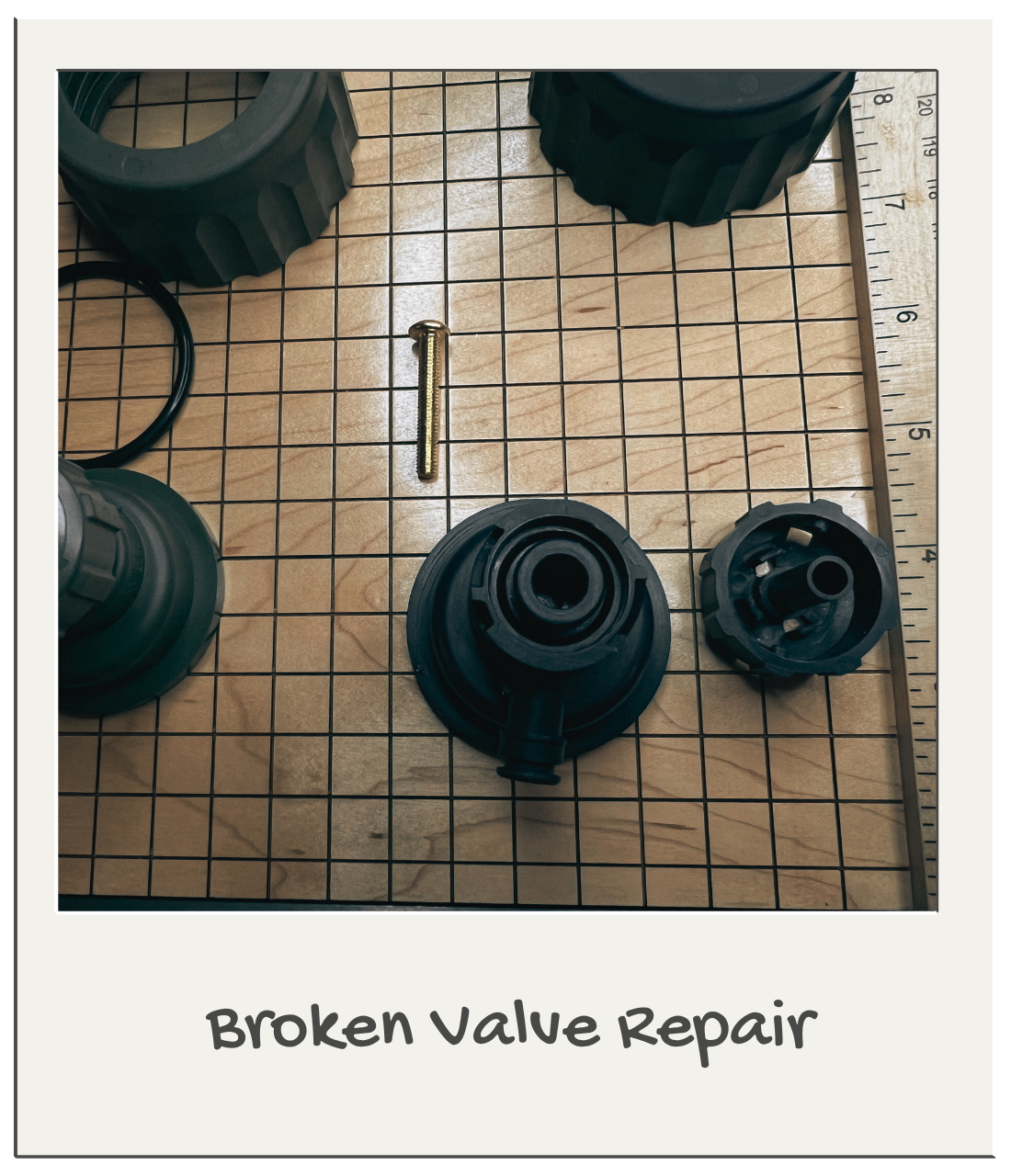
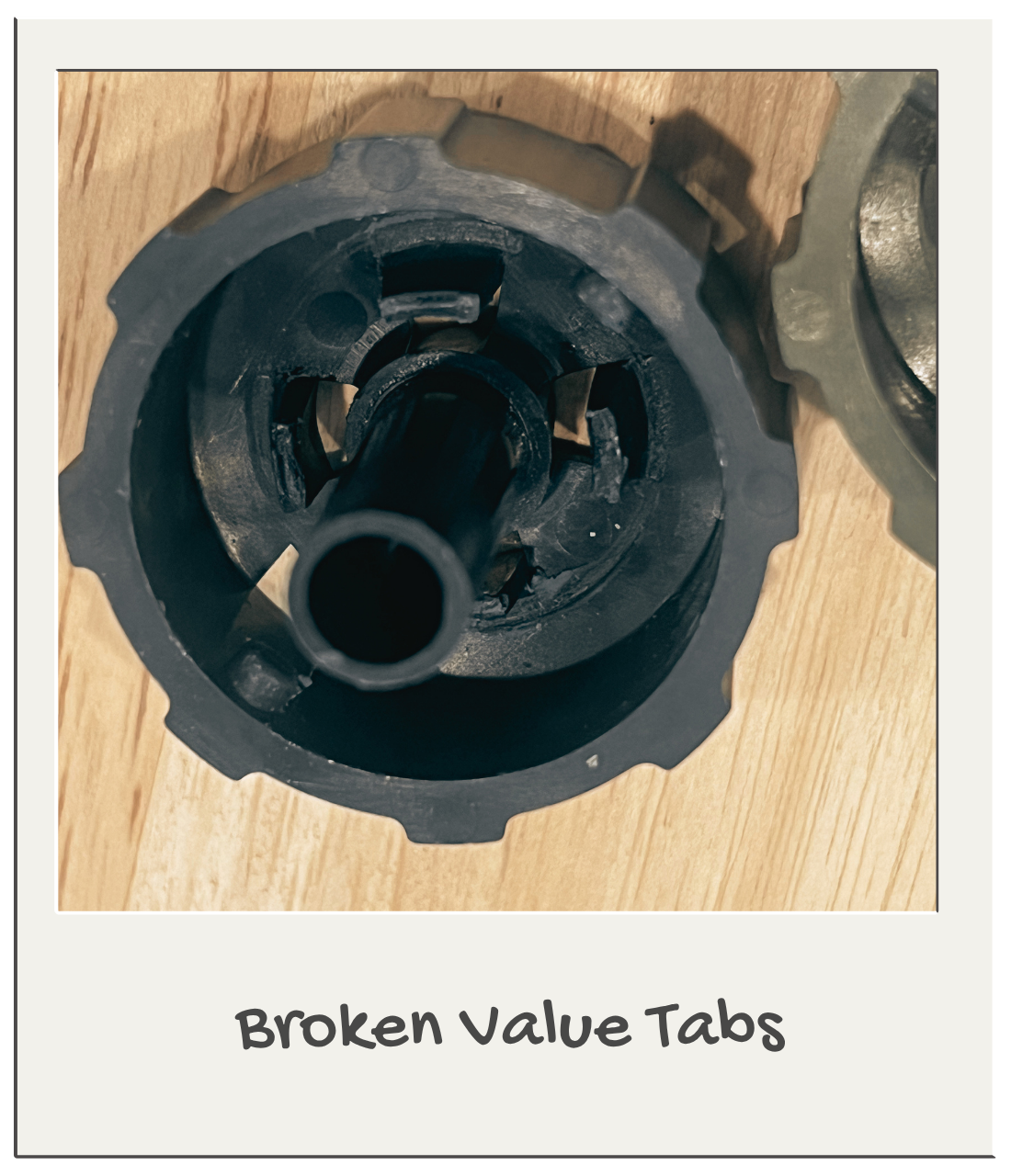
After disassembling the failed components, I found several small molded plastic retaining tabs surrounding the internal valve stem. These tabs appear to capture the central actuator or plunger assembly and keep it positioned inside the tap housing.
That is where the fragments I had found beside the Jerrycan started telling the story.
The spring-loaded valve mechanism places continuous force within this assembly. The Jerrycan itself also operates under internal pressure. As long as the retaining features remain intact, the actuator stays where it belongs and the valve functions normally.
Once enough of those small retaining tabs fail, however, the actuator can apparently separate from the housing. At that point, the valve is no longer retained in its intended position and pressurized water can escape.
In the first failure, I remember finding at least three small broken plastic pieces near the Jerrycan. I no longer have those fragments, so I cannot inspect or measure them now. Their general shape, however, appeared consistent with the missing portions of the retaining structure I later observed after disassembling the tap.
That gave me a failure location.
It did not necessarily give me a root cause.
There is an important difference between the two.
Without LifeSaver's material specifications, dimensional tolerances, pressure data and controlled testing, I cannot responsibly say exactly why those retaining features failed. I can only document what I experienced, identify where both failures appear to have occurred and develop a working hypothesis from the evidence available.
That also led me to one of the first questions I would ask if I were evaluating this from the manufacturer's side.
It is a reasonable question, especially with a manually pressurized water purifier.
Based on how we actually used the Jerrycan, unusual pressurization or extreme heat does not seem like a convincing explanation for both failures.
We generally needed only a couple of pump strokes to get good water flow. There were times when the container remained pressurized overnight or for a few days during a camping trip, but it was not routinely stored under pressure for weeks or months.
The two failures also occurred under very different circumstances.
One happened indoors.
The other happened while camping with daytime temperatures in the low 80s and nighttime temperatures in the low 70s.
Those are fairly ordinary conditions for an outdoor water system designed to travel.
Pressure may still contribute to the loading of the internal components, but our use does not appear to represent some unusual edge case where the product was being subjected to extreme temperatures or excessive pumping.
There was another variable that I think may be more interesting.
We used the tap a lot.
When our daughter was drinking formula, we were drawing water from the LifeSaver approximately six to eight times every day.
That created an interesting use pattern.
The Jerrycan itself did not necessarily require frequent pumping because it held enough pressure to continue dispensing water. The tap, however, was being actuated over and over again throughout the day.
That distinction may matter when thinking about the failure.
If the retaining tabs are experiencing a combination of spring preload, internal pressure and repeated movement from the valve actuator, then the number of dispensing cycles could be just as important as the number of times the Jerrycan is pressurized.
Again, I cannot prove that from two failed components sitting on my workbench. It is simply where I would begin testing.
My working hypothesis is that the molded retaining features experience some combination of:
There may also be a cascading element to the failure.
Imagine that the load is being shared across several small retaining tabs. If one tab develops a crack or breaks completely, the forces that had been distributed across the entire retention structure are now carried by fewer remaining tabs. If another fails, the load becomes even more concentrated.
Eventually the remaining structure may no longer be able to retain the actuator.
What appears from the outside to be a sudden failure could actually be the final moment of a process that had been developing slowly over hundreds or thousands of valve cycles.
That sequence would also be consistent with finding several plastic fragments after the tap suddenly released.
I would want considerably more data before calling that the definitive failure mode, but the repeated damage around the same small retention features is where I would focus engineering attention first.
And once I understood that, another question became more interesting.
Could the failed tap still work if those plastic tabs were no longer responsible for retaining the actuator?
I like taking things apart for the same reason I like optimizing websites. Once you understand where the friction lives, the solution often becomes much smaller than the original problem made it seem.
The entire LifeSaver tap did not appear broken.
Most of it was perfectly functional.
The spring still worked. The actuator still worked. The surrounding housing still worked. What had failed was the mechanism responsible for keeping those components together.
So I experimented.
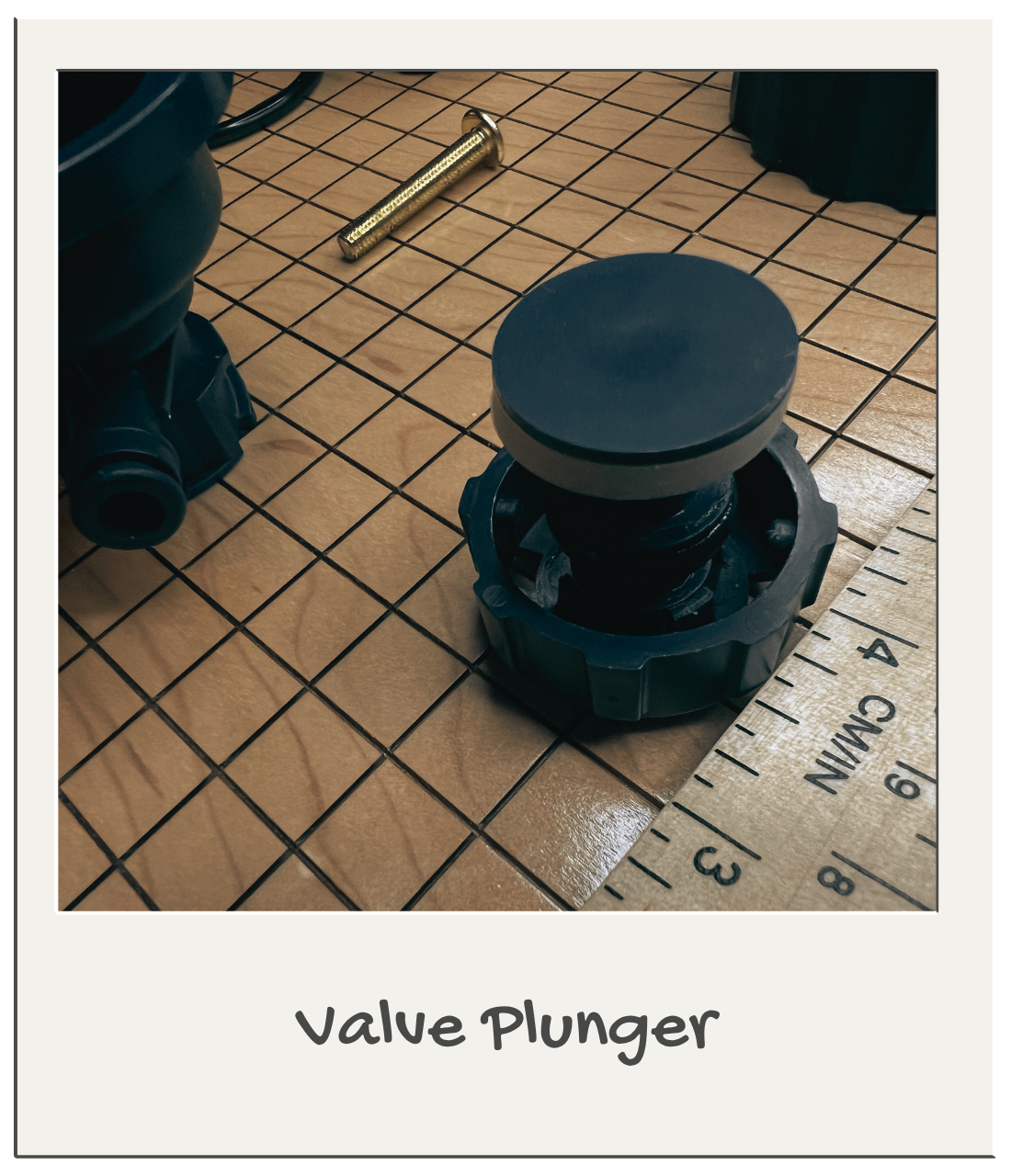
I drilled through the center of the actuator assembly and mechanically captured the components with a screw while reinstalling the original spring. The goal was not to create a polished permanent repair. I simply wanted to test whether positive mechanical retention could replace the function previously performed by the molded plastic tabs.
It worked.
The repaired valve operates and dispenses water.
I currently consider it an experimental backup rather than a production-quality repair. The hardware I used was what I had available at the time, and that distinction is particularly important because this is a potable-water system. Any permanent repair should use materials appropriate for drinking-water contact and the environment in which the Jerrycan is used, including suitable corrosion-resistant hardware.
I would not tell another Jerrycan owner to drill through their tap based solely on my experiment.
What the experiment demonstrated was more useful than the repair itself.
The entire tap may not need to change. The way one internal component is retained might.
If I were exploring a version 2 with LifeSaver's engineering team, I would start with the least disruptive options.
The existing molded tabs might simply need greater root thickness, revised geometry or a polymer better suited to the combination of sustained and cyclic loading they experience. Testing could determine whether relatively small changes increase durability enough to solve the problem without meaningfully changing manufacturing or assembly.
The direction I find more interesting would separate assembly from long-term retention.
The plastic features could continue locating the actuator during manufacturing while another component takes responsibility for keeping it there over the life of the product. A stainless retaining clip, ring, pin or other positive mechanical feature could potentially accomplish that without requiring a complete redesign of the valve.
My field repair was essentially a crude proof of that concept.

There is also a more ambitious version I would love to see explored for a product intended for camping, overlanding, preparedness and expedition use: a replaceable valve cartridge.
If the working parts of the tap were contained within a small serviceable cartridge, a user could carry an inexpensive spare alongside filters and other maintenance items. A damaged valve would become a field-serviceable component instead of potentially taking an otherwise functional water purifier out of service.
Whether that makes financial or manufacturing sense is something LifeSaver would have to determine. Added components create their own complexity, and sometimes the simplest design remains the best design.
But field serviceability has real value when a product is specifically designed to operate away from home.
When your water system is sitting on a kitchen counter, a broken tap is inconvenient.
When the same system is your primary source of purified water at a remote campsite, that small component suddenly carries much more responsibility.
That is why I think this failure is worth examining.
The way LifeSaver responded matters just as much to me as the failed component.
After the second failure, I contacted the company and explained what had happened. Their customer service was excellent. They listened to the issue, discussed it with me and sent a replacement system via DHL at no charge.
During that conversation, I was also told that LifeSaver was aware of the issue and working on a solution.
I appreciate that response.
The replacement I received appears, from my own inspection, to use the same general internal tap geometry, so I will continue paying attention to how it performs over time. I cannot speak to whatever changes LifeSaver may be developing internally or whether a revised component will eventually enter production.
What I can say is that I walked away from the experience with more respect for the company, not less.
Products used in the real world eventually reveal things that prototypes, test fixtures and design reviews cannot always predict. Customers use equipment differently. They leave it pressurized. They actuate a valve thousands of times. They take it from the kitchen to a boat to the back of a truck and then into a campsite.
That is where field experience becomes valuable.
A company willing to listen to those observations has an opportunity to make an already good product better.
And I want to be very clear about something else.
I would still recommend the LifeSaver Jerrycan.
The purification system is why I bought it in 2022, and nothing about these tap failures has changed my opinion of the usefulness of the overall product or the trust we placed in the water it produced.
We trusted that water enough to prepare our daughter's formula with it.
I do not say that lightly.
My criticism is focused on a small mechanical retention feature inside the tap because that appears to be where both of my failures occurred. If that weak point can be strengthened, an already excellent product becomes more dependable in exactly the kinds of environments where dependability matters most.
That is also why I wanted to document this as a Product Refinement rather than simply leave a review.
Reviews usually capture whether someone liked a product.
Long-term use can tell us something more valuable.
It can show us where a product succeeds so consistently that we begin trusting it without thinking about it. It can reveal the small components carrying responsibilities we never noticed. And occasionally, when something finally breaks, it gives us an opportunity to look through the failure and understand what the product may be asking for next.
Product Refinement begins with using good products long enough to understand them. Sometimes that means finding the small decisions that separate a product you already trust from the version you would trust even more.
If you have further questions or just want to chat about my experience, reach out. I'd love to connect.

The first step is a conversation. You do not need a perfect idea. You only need curiosity and a sense that your idea could become something stronger.