.png)

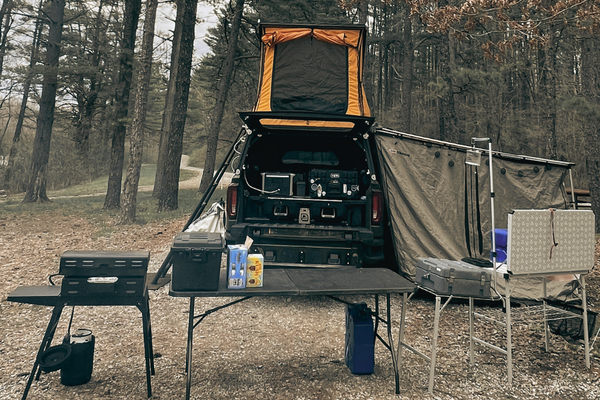
There is a funny thing about camping that I don't think I fully appreciated until I had done enough of it. Most of what we do at camp is remarkably ordinary.
We wake up. We make coffee. We figure out breakfast. We clean things up, organize our stuff, talk about what we might do that day and eventually start thinking about the next meal. If you're camping with a kid, there are even more reminders that everyday life came along for the trip. Things still need cleaned. Someone still needs changed. Something gets spilled. Somebody can't find what they were just holding.
Camping doesn't remove much of life. It just removes a surprising amount of what normally competes with it.
At home, making coffee can happen while checking email, thinking about work, reading a notification and half-listening to something playing in another room. Breakfast happens while mentally arranging the rest of the day. A conversation gets interrupted because a phone lights up on the table. Even sitting still can feel strangely difficult because we've become accustomed to filling empty space the moment it appears.
At camp, coffee is just coffee for a little while. You heat the water. You wait. Steam rolls off the top when the morning is cool enough. Somebody is moving around inside the camper. Maybe there are birds making more noise than you noticed the night before. You pour the water slowly because that's how a pour-over works, then you sit down and drink it.
Nothing particularly remarkable happened. And somehow, that is exactly what feels remarkable.
Camping is just everyday life with fewer distractions competing for your attention.
I think that's a big part of why I keep going back.
People talk about getting outside as an escape, and I understand why. There is certainly something satisfying about leaving work, traffic, schedules and the familiar walls of home behind for a few days.
But “escape” has never quite described what I experience. The longer I've camped, the more I've realized that the routine itself doesn't change very much. What changes is where my attention goes.
Outside, there are fewer invisible things asking for a piece of it. The weather matters because you're actually living in it. You notice where the sun is because it determines whether your chair is comfortable or whether the camper is about to get hot. You pay attention to how much water you have, whether the fire needs another log and when the temperature begins dropping after sunset.
These are small things, but they are immediate. There isn't much abstraction between the observation and what it means.
Rain is coming, so move the chairs. It's getting dark, so turn on the lights. The water is getting low, so fill it. The coffee is ready, so sit down.
Compare that with how much attention gets consumed at home by things that aren't physically happening anywhere near us. A headline from another state. An email about something happening next Tuesday. A notification generated because an algorithm decided we hadn't opened an app recently enough. A problem at work we cannot solve at 9:30 at night but somehow continue solving in our heads anyway.
None of those things are inherently meaningless. They simply accumulate.
Eventually so many things are asking for attention that we stop noticing where our attention is going.
Camping makes that harder to do.
This has also changed how I think about outdoor gear.
I've spent years refining our truck and Go Fast Camper setup, and from the outside it would be easy to interpret that as wanting more stuff. In reality, almost every improvement I've kept has survived the same test:
Does this make camp easier to live in without demanding more attention from us?
The Go Fast Camper itself changed how quickly we could move between traveling and actually being at camp. Combined with the DECKED drawer system, most of what we need already has a place. We aren't unloading half the truck every time we stop or digging through a pile of bins because the thing we need inevitably migrated to the bottom.
That doesn't sound profound. It isn't supposed to be.
It means I spend less of Saturday managing camping equipment and more of Saturday camping.
The same pattern shows up in smaller things. Our Hest sleep setup means we're not waking up sore and exhausted after a night outside. The Anker SOLIX F1200 quietly handles power, including Brittni's CPAP, without a generator becoming part of the soundtrack of camp. The ARB awning means rain doesn't automatically send everyone inside. Our Everfrost cooler removes the constant cycle of buying ice, draining water and rearranging food as everything slowly becomes wet.
Even my Stanley pour-over has earned its place for almost the opposite reason. It doesn't make coffee instantaneous. It makes coffee a ritual. There is a difference.
Some friction is worth removing because it distracts us from the experience. Other things are worth doing slowly because the experience lives inside the process. I've become increasingly interested in knowing the difference.
A good camping setup shouldn't insulate you from being outdoors. It should quietly remove enough unnecessary work that you have more attention available for being there.
The best gear almost disappears once you're using it.
That's probably why I have become so interested in product refinement too. The products I appreciate most rarely demand that I think about how clever they are. They simply understand the environment well enough to support what I'm already trying to do.
Ask someone about a camping trip a year later and they probably won't remember how efficiently they packed the truck.
They remember the storm that rolled through after dinner.
They remember their kid throwing rocks into the creek for an hour.
They remember the ridiculous conversation that somehow lasted until midnight because nobody realized how late it had gotten.
They remember waking up cold.
They remember the first cup of coffee.
They remember somebody burning dinner.
They remember sitting under the awning while rain hit the fabric overhead and realizing there was nowhere else they particularly needed to be.
I've had conversations beside a fire that probably wouldn't have happened sitting across from the same person at a restaurant. There is something about a campfire that changes the pace of conversation. Nobody has to fill every silence. Looking into the fire gives your eyes somewhere to go while you're thinking. Stories wander a little more. Questions don't always need immediate answers.
Sometimes everyone just sits there. That kind of silence can feel almost foreign at first.
Modern life doesn't leave much empty space alone. If we have thirty unoccupied seconds, there is a device in our pocket specifically designed to fill them. Outside, the empty spaces begin filling themselves.
Wind moves through the trees. Somebody adjusts a chair. The fire collapses and sends sparks upward. A bird makes a noise none of us can identify. Somebody eventually says something. You start noticing again.
I want to be careful about turning camping into a prescription for mental health. Getting outside doesn't make life's problems disappear, and I don't think every difficult emotion can be solved by spending a weekend in the woods.
But I have noticed what happens to me when the amount of competing input decreases. My thoughts have somewhere to go.
Things that felt enormous during the week sometimes return to their actual size. Conversations I didn't realize I needed begin naturally. I move more without scheduling “movement.” I spend longer doing one thing at a time.
There is less pressure to perform every moment productively. That last part may matter more than we realize.
At home, rest can somehow become another thing we're supposed to optimize. Sleep scores. Step counts. Morning routines. Productivity systems. Meditation streaks. Even the things intended to help us slow down can become another dashboard telling us whether we're doing life correctly.
Camp doesn't care.
The fire doesn't know whether I had a productive week. The trail doesn't know what I do for work. The creek is completely indifferent to my inbox. For a little while, the environment asks much simpler questions.
Are you warm?
Are you hungry?
Is everyone comfortable?
Is rain coming?
Do we have enough water?
Should we put another log on?
There is something grounding about returning attention to things that can actually be observed and acted upon.
I've written before about how the world often announces change before it reveals the reason for the change. The outdoors gives us an unusually good place to practice noticing those signals because so much of the noise has been removed.
You notice the temperature drop before the rain. You notice the wind change. You notice the woods getting quieter. And, given enough time, you sometimes begin noticing changes in yourself with the same kind of attention.
The interesting part of camping for me isn't really what happens while we're gone.
It's what becomes obvious when we come back.
After a few days outside, home can feel incredibly loud even when nobody is making noise. There are screens everywhere. Things blink. Appliances hum. Notifications return. There are dozens of objects within arm's reach that exist primarily to make something faster.
And I like many of those things.
I'm not interested in pretending modern life is terrible or that we'd all be happier abandoning our houses for tents. I enjoy air conditioning. I like fast internet. I have spent an unreasonable amount of my professional life helping make digital experiences better.
Camping hasn't made me want less technology.
It has made me more aware of what deserves my attention.
That distinction has followed me into almost everything else.
It's part of how I think about websites. A good digital experience shouldn't constantly fight for someone's attention. It should help them use that attention well.
It's part of how I think about products. The best product isn't always the one with the most capability. Sometimes it's the one that quietly removes a recurring frustration.
It's part of how I think about routines. The most sustainable ones rarely require constant motivation. They create conditions where the right behavior becomes easier.
And it's part of how I think about people.
Sometimes being useful to someone doesn't require solving whatever they're carrying. Sometimes you just create enough room for them to hear themselves think.
Maybe that's one reason campfires have been such enduring gathering places. They give us somewhere to sit while nothing else is demanding that we move.
Camping has taught me that I probably don't need extraordinary experiences nearly as often as I think I do.
Some of my favorite moments outside would sound painfully boring if I tried to explain them. Coffee before everyone else wakes up. Josie discovering something on the ground that I've walked past a hundred times. Brittni and me talking after the campsite gets quiet. Music playing low enough that you can still hear everything around it. Cooking something simple when you're hungry enough that it tastes incredible. Rain hitting the awning. Throwing another piece of wood on the fire because nobody is ready to go to bed yet.
None of those things are exclusive to camping.
That's the point.
The people are the same people. The coffee is the same coffee. We still eat, sleep, clean things, make decisions, solve problems and occasionally get irritated with each other.
Camping doesn't replace everyday life. It makes everyday life easier to notice.
And every time I come home, I wonder how much of that attention I can bring back with me. Because maybe the lesson isn't that we need to escape our lives more often. Maybe we just need places that remind us how much of our lives we've stopped noticing.
Camping often reduces the number of competing inputs demanding our attention. Daily routines become simpler and more immediate, which can create more room for conversation, observation, movement and rest. The experience varies by person, but the reduction in digital and environmental distractions can be an important part of why time outside feels different.
Camping changes the context surrounding ordinary activities. Making coffee, cooking dinner or sitting with friends can receive more of our attention because fewer unrelated things are interrupting the experience.
The most useful gear tends to reduce recurring friction without becoming another thing that needs constant management. Reliable shelter, sleep, power, food storage and weather protection can make it easier to focus on the experience rather than continually managing equipment.
No. Comfort and reliable equipment can make camping easier, but many of the experiences people value most outdoors come from time, attention, environment and the people they're sharing it with.
Campfires naturally create a slower environment with fewer interruptions and less pressure to fill every moment. That can make longer conversations and comfortable silence feel more natural.

The first step is a conversation. You do not need a perfect idea. You only need curiosity and a sense that your idea could become something stronger.